Mix It Up: Why Jumping Between Puzzle Types in One Session Makes You Sharper, Not Scattered
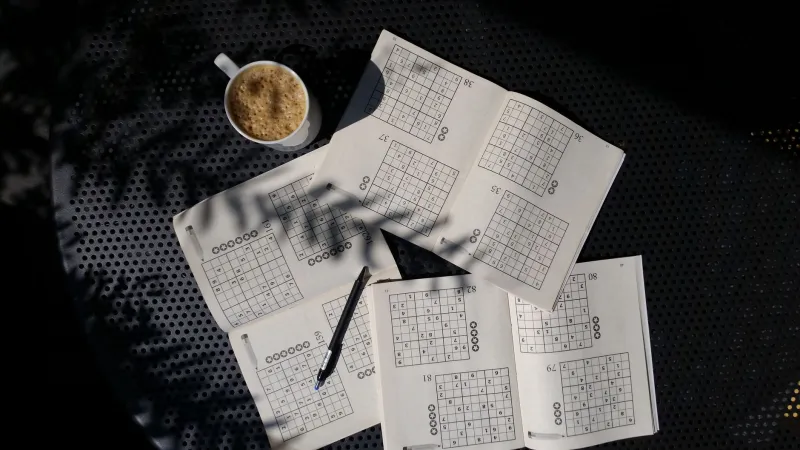
Most puzzle advice sounds like it was written by someone who's never actually been bored mid-session. Stick to one type. Master the fundamentals before diversifying. Build a routine and don't deviate from it. It's solid guidance in theory — except that a lot of dedicated puzzle solvers hit a wall with it. The sessions start to feel mechanical. The engagement drops. You're going through the motions on your fourth sudoku of the day and your brain is somewhere else entirely.
What if the advice itself is part of the problem?
There's a compelling case — backed by actual cognitive science — that deliberately mixing puzzle types within a single session doesn't fragment your focus. It sharpens it. And once you understand why, you might never approach a solo puzzle session the same way again.
The Interleaving Effect: Practice Science's Best-Kept Secret
Educational psychologists have a term for the strategy of mixing different types of practice within a single session: interleaving. And the research behind it is striking enough that it's reshaping how educators approach everything from math instruction to athletic training.
The classic demonstration comes from studies on motor learning and academic skill-building. When learners practice multiple problem types in alternating order — rather than doing all of Type A, then all of Type B — they perform worse during the practice session but significantly better on later tests. The mixing creates what researchers call "desirable difficulty." Your brain has to work harder in the moment to retrieve and apply the right strategy for each new problem type, and that extra retrieval effort strengthens the underlying neural encoding.
For puzzle solvers, this translates to something pretty practical: the mild disorientation you feel when you switch from a sudoku to a crossword to a logic grid isn't a sign that you're doing it wrong. It's a sign that your brain is doing more work than it would if you just stayed in one lane.
What Each Puzzle Type Is Actually Training
To understand why mixing works so well, it helps to get specific about what different puzzle types are actually asking your brain to do.
Sudoku is primarily a constraint satisfaction problem. You're holding multiple interdependent variables in working memory, applying elimination logic, and managing a spatial grid. The core cognitive demands are pattern recognition, logical deduction, and working memory management.
Crosswords are fundamentally about lexical retrieval and associative memory. You're pulling words from long-term storage based on partial information and contextual clues. The cognitive demands are almost entirely different from sudoku — it's more like searching a database than solving an equation.
Logic grid puzzles (the kind where you're figuring out which person owns which pet based on a set of clues) share some DNA with sudoku but rely more heavily on relational reasoning and explicit deductive chains. You're building and testing logical propositions in a more verbal, structured way.
Brain teasers and lateral thinking puzzles are the wild cards. They often require you to abandon your current mental model entirely and reframe the problem — a cognitive skill called insight thinking that's distinct from the systematic approaches the other puzzle types reward.
When you mix these in a single session, you're not just doing different things. You're exercising completely different cognitive systems, which means each shift acts as a kind of active rest for the systems you were just using.
Building a Mixed Session That Actually Works
Not all mixing strategies are equally effective. Randomly jumping between puzzle types every two minutes is probably going to leave you frustrated rather than sharpened. The goal is structured variety — enough switching to engage the interleaving effect, but enough continuity to let you actually engage with each puzzle type meaningfully.
Here's a framework that works well for most solvers:
The Sandwich Method: Start with a sudoku (your anchor puzzle — the thing you're primarily trying to improve). After completing it, switch to a crossword or word puzzle for one round. Finish the session with another sudoku. The middle puzzle acts as an active rest that lets your brain consolidate the logical strategies from the first sudoku while you engage a different cognitive system. When you return to sudoku, most solvers report feeling noticeably fresher.
The Circuit: For longer sessions, rotate through three or four puzzle types in a fixed order — sudoku, logic grid, brain teaser, crossword — and repeat the circuit once or twice. This mimics the interleaving structure that performs best in research settings.
The Difficulty Ladder: Mix puzzle types AND difficulty levels simultaneously. Easy crossword, medium sudoku, hard logic grid. This creates both horizontal variety (different types) and vertical variety (different challenge levels), which keeps the cognitive engagement high throughout the session.
When Sticking to One Type Still Makes Sense
Fair is fair — the "one type" approach isn't worthless. If you're actively trying to prepare for a specific challenge (a competitive sudoku tournament, for example, or a logic-heavy professional certification exam), focused practice on that specific type has clear value. Specificity of training matters when the outcome is specific.
But for the vast majority of puzzle solvers — people who are doing this because they love it and want to keep their minds sharp — the specialization argument is weaker than it sounds. General cognitive flexibility, the ability to shift problem-solving approaches fluidly, is probably more valuable day-to-day than deep expertise in a single puzzle format.
And honestly? Mixed sessions are just more fun. There's something genuinely energizing about finishing a tricky sudoku and then pivoting to a crossword clue that makes you laugh because you should have gotten it immediately. That variety is its own reward.
The Burnout Factor
One thing the research doesn't always emphasize enough: monotony is a real cognitive threat. When puzzle sessions become predictable and repetitive, engagement drops, and low-engagement practice is barely better than no practice at all. You've probably experienced this — the zombie-solving phenomenon where you're filling in boxes but not really thinking.
Mixed sessions are a structural solution to this problem. The novelty of switching puzzle types keeps your attention honest. You can't coast through a logic grid the same way you might coast through a too-familiar sudoku format. The shift in demands forces re-engagement.
For solvers who have been feeling a little flat lately — or who've noticed that their improvement has stalled even though they're putting in consistent time — mixing puzzle types might be exactly the disruption their routine needs.
Start Small
You don't need to overhaul your entire puzzle practice overnight. Try this once: next time you sit down for a session, do two sudokus, then switch to a crossword or a logic puzzle for one round, then come back to sudoku. Just notice how that transition feels. Notice whether you approach the second sudoku differently than you approached the first.
Chances are, you'll feel the difference. And once you do, you'll understand exactly why the grid is always more interesting when it's not the only thing on the table.